Records of the Past, 2nd series, Vol. I, ed. by A. H. Sayce, [1888], at sacred-texts.com
1. Assur-natsir-pal (II), the great king, the mighty king, king of the world, king of Assyria,
-
son of Tukulti-Uras, the great king, the mighty king, king of the world, king of Assyria, son of Rimmon-nirari,
-
the great king, the mighty king, king of the world, king of the same Assyria,
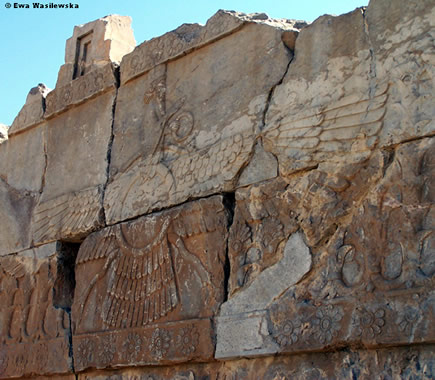 (Ashur protects his king from above)
-
the warrior chief, who with the help of Assur (Orien / Osiris) his lord
-
has marched, and among the princes of the four regions 1
-
his rival has not had; the king who from
-
beyond the Tigris to Lebanon and the great sea,
-
Laqi throughout its circuit,
-
’Sukhi 2 as far as the city of Rapiqu to his feet
-
subdued; from the source 3
-
of the ’Supnat 4 to the passes of
-
Kirruri, to Gilzani, 5
-
from the other side of the lower Zab
-
to the city of Til-bari, which (is) above
-
Zaban, from the city of Til-sabtani
-
to the city of Til-sa-zabdani,
-
the city of Khirimu, the city of Kharutu, the fortresses
-
of Kar-Dunias 1 to the territory
-
of my country I restored, and the broad
-
lands of Nairi throughout its whole extent
-
I conquered. That city I took anew;
-
Imgur-Bel its name I called;
-
this temple with the brick of my palace
-
verily I built; an image of Makhir (unknown, Marduk ?)2 my lord
-
in the midst verily I set up; to Lebanon
-
verily I went; beams of cedar,
-
of cypress, of juniper I cut;
-
beams of cedar upon this temple
-
I fastened; doors of cedar
-
I made; with a rim of copper I overlaid (them);
-
at its gates I fixed (them); this temple
-
I furnished, I made great; Makhir the great lord
-
in the midst I seated; an inscribed tablet in his temple
-
I placed. O later prince of the kings

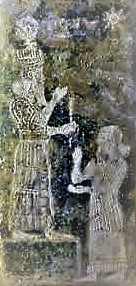 (Ashur; Ashur directs his Assyrian mixed-breed king)
35. my sons, whom Assur shall call,
36. (if) this temple decay, (and) the tablet thou see, and
37. read, its ruins do thou restore; thy name with my name write; 3
38. to its place do thou bring (it) back! Assur the lord, the great one, Makhir,
39. who dwells in this temple by their favorite 4 rightly
40. shall triumph; his tablet, his name, his seed in their land may they establish!
- He who the tablet shall see, and offense in plenty
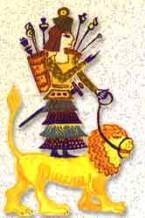
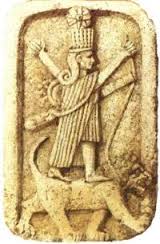 (Inanna, Goddess of War upon her zodiac symbol Leo)
42. speak, may Ishtar (Inanna)__, lady of fight and battle,
43. his weapons break in pieces, his throne
44. take from him! 1 He who the tablet shall see, and
45. read, (and) anointing the pavement-stones, sacrificing a lamb,
46. to its place shall restore (it), Assur the great lord his prayers
47. shall hear, (and) in the battle of kings, the field
48. of engagement, his heart’s desire 2
49. shall cause him to attain.
Footnotes
83:1 The translator in the Transactions of the Society of Biblical Archæology, p. 71, reads ina sar sa kiprat arbata, having evidently mistaken the wedges of the plural-sign for the character for “king.” 83:2 The Shuhites of the Old Testament (Job ii. 11), on the west bank of the Euphrates between the Balikh and the Khabour. 83:3 Ris ini, the source: not riseni, as one word, which would be, if anything, an anomalous plural from risu. 83:4 The Sebbeneh Su, which forms one of the sources of the Tigris north of Diarbekir. 83:5 [Or Guzan (Gozan).] 84:1 Babylonia. 84:2 In W. A. I., ii. 58, 12, Makhir is called “the daughter of Samas” (Utu); but the same deity is invoked as a male in one of the penitential psalms (W. A. I., iv. 66, 2) translated by Zimmern (Busspsalmen, p. 100), and Sayce (Hibbert Lectures, p. 355), “May Makhir_, god of dreams, rest upon my head!_” 84:3 There is no need here for an amendment of the text, which is plainly as follows: sumi-ka itti sumi-ya sudhur. 84:4 The phrase nisi ini, literally “the raising of the eyes,” means “grace” or “favor,” hence the object of such grace or favour, a favourite or darling (Liebling, Delitzsch). 85:1 By separating lu from the verb and giving it a temporal meaning the translator in T. S. B. A. (p. 78) has missed the force of this passage, which is clearly precative. See Delitzsch, Assyrian Grammar, p. 260. 85:2 Ammar libbi = mâla libbi, literally “the fullness of the heart;” cp. Esarhaddon, Hexagonal Prism, Col. iv. 41, amtsu mâla libbi, “I attained my heart’s desire.”